
“We need to witness our own limits transgressed, and some life pasturing freely where we never wander” -Thoreau
Day 1
“As little as possible”, Silje said. “As little as possible”, I think, eating the last pieces of candy, clumsily taking them out of the bag with frozen fingers barely moving. Only a few minutes more, and I have to keep moving. Only a few minutes to pee, eat, drink tea, and continue walking in this harsh world of unspeakable beauty.
“As little as possible” was Silje’s motto for the amount of cigarettes smoked and beers drunk on her summer-long vacation of hut-hopping around Norway. I had met her the day before, at Sota Sæter, the starting hut of the Massiv Trail.
“3 years ago, I walked the Massiv Trail” Silje told me, lying comfortably in her reclining sun chair on the hut’s terrace as the rain clouds engulfed the valley. “But this summer, I intended to enjoy and take a more relaxing holiday.” She passionately inhaled the smoke and opened another beer can. “Perhaps I do the same next summer”, I fantasised. In front of me, there were 350 kilometres and 18 days through some of Norway’s wildest landscapes and highest altitudes.
In the morning, Silje came into the dorm room, visibly swaying and stumbling.
“I’m afraid for you,” she said with a cracking voice.
“It’s okay. It seems the rain is calming down” I downplayed my own worry and the discouraging forecast for the foreseeable future. I went to the terrace, sat on a wooden stool and took out the gas stove. Coffee and oatmeal for breakfast, tea for walking. Silje had passed out and was snoring comfortably in the room. It seemed the rain had retreated. It was my sign to start. Two hours and a steep ascent over the first uphill later; cold, wind-swept rain engulfed the passage.
I walk fast over patches of snow and a mass graveyard of rocks. A cone-shaped mountain covered in layers of snow lies dreadfully still next to the path. A dreadful, dark mountain, like a devil giant seated on its ice throne on a planet of permanent winter. I glance and admire its desolate beauty yet quickly look away and hurry my step. It stirs something terrifying in me. It is a reminder of the virtually complete isolation in which I find myself, and that things could go terribly wrong. How cold do I have to feel before freezing? At what point is it too cold?


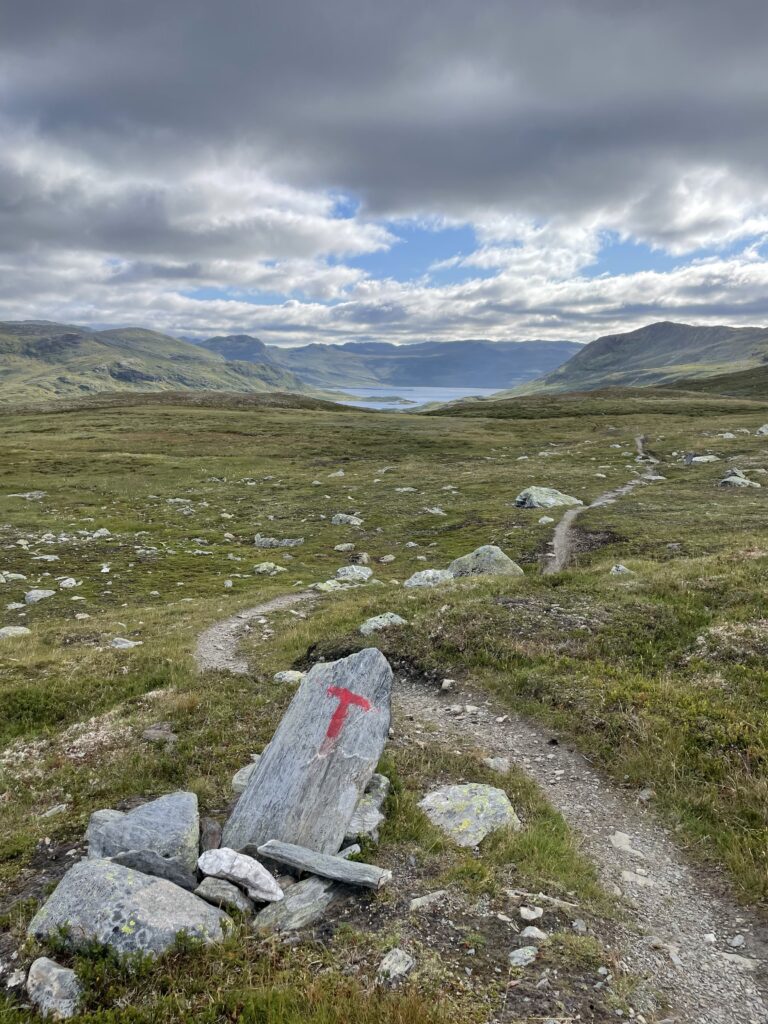
Eventually, the path begins to descend, and now a long lake lies in front, still as a lead-filled bowl. In the distance, two cloaked figures are slowly crossing a stream pouring down into the lake. I walk even faster, trying to catch up with the strangers. The stream is overflowing, each stepping stone submerged beneath a layer of freezing water. A red T marking stands like a blood rune on tomb-like stone on the other side. I spend 5 minutes looking for the best way to it. It is pointless, so I step right in. At first, it seems wrong to do so, but it becomes liberating, to just cut through it, as if cutting the Gordian knot.
The two cloaked figures turn around, and big smiles erupt on their wrinkled faces. They must be over 60.
“Hi”, they greet me happily as if on a summer holiday.
“Hi, how are you?” I ask, hiding my desperation.
“It’s not bad…but how are you?” the lady asked, the question stinging me painfully.
“It’s okay, a little bit cold.”
The lady glances at my wrecked, short raincoat. Their big backpacks are completely covered in gigantic raincoats—ropes and harnesses hanging around them. They are Dutch, they say, and they absolutely love to spend time in my warm home country.
“Why are you here and not in Croatia?”
“I ask myself the same thing”.
We both fantasise about Croatia for a brief time, but the cold doesn’t allow a long break. I worry about them; their steps are slow and equipment heavy. They probably worry about me too. But it is the first day, I came here alone, and I must be able to continue alone.
“After you”, they step aside.
The path ahead is a navigation over the rocky shore of the Illvanet lake. Its silent stillness is deafening. There is another stream cutting the way, pouring into the alien lake, and I start cursing whoever designed the trail.
3 hours and 8 stream crossings later, Illvanet is finally behind, yet the hut is not in sight. The rain is pouring down again, as strong as ever. The trail becomes a mud trench stretching into the grey distance. I bite on the drawstring of my raincoat to keep it from being blown off by the wind and scream into the grey valley in agony. “Keep on walking”, I repeat to myself desperately over and over again. “It must be just around that mountain.” Rain is dripping down my face, together with tears. I’m completely soaked, and my feet have been wet for the last 10 hours. A twisted thought appears, an image of the dearest people in that cruel rain. My spirit breaks imagining my mother shivering from cold, and from the bottom of my heart, I wouldn’t wish this on anyone, and certainly, I wouldn’t wish her to see me now. Is this why I’m doing it, so others wouldn’t have to endure it? Is this why I came here?
Day 20
It is 10 in the morning in Hellevasbu hut, the starting point of the last section of the Massiv Trail. People in front of the hut are cheerful as the sun shines brightly, a glorious salutation to the end of Norwegian summer. It is hard to be strict with the schedule on a beautiful day.
I arrived to Hellevasbu yesterday, hoping to find my friend. “Mads is not here”, others informed me. “He sends his warmest regards”. We had met on the trail and walked a significant portion of it together, finishing each day with a glorious feast, decimating storage of food in Norwegian huts. Mads ate loudly, shamelessly expressing his enjoyment, a habit significantly irritating my ear. Now he is one day in front, and I miss him and his chewing.
I walk south towards the trail, saluted with greetings and good lucks from Norwegians whose warmth comes through once they leave their urban homes for the remote wilderness where their hearts truly lie.
Soon, the trail climbs up steeply, as expected. Laughter disappears in the background, and the comforting presence of people falls into the silence of the surrounding mountains that stand like brutalist monuments to primordial times. Now, there is nothing more but the slow reality of walking further, and the exhaustion accumulated in the legs over the past 19 days.
High on the plateau, boulders are scattered as if some giants left them there after an ancient dice game, waiting to be picked up again in the future inconceivably distant. Small bubbles of air expand out of the sand watered gently by the lake, like the very earth is breathing—as if the globe were turned wrong side outward”, Thoreau said, and “what is man but a mass of thawing clay?” I press my palms into sand, seemingly imprinting them for eternity, until the giants come back to continue the game.
I keep on walking with sand on my palms, significantly more at peace. The final spectacle reveals itself in front; a vertical black mountain rising from the ground like an iron wall, erected to protect some elvish kingdom hidden behind. Several lakes stretch in the valley beneath it, like an accidental spillage of blue on an otherwise carefully crafted painting.
From the side, I hear a hidden waterfall crushing over the rocks like a relentless mill, and water particles rise in smoke above it; a sound one gets used to on the Massiv Trail, a sound so pure it can be tasted in the air.


The path descends to the lakes, and there won’t be a better occasion, probably. I put down my backpack, take my clothes off and lay it on a rock by the lake. I take out the towel, already calculating the most efficient way to get in, out, dry and put the clothes back on.
A familiar yet never-to-be-gotten-used-to shock spreads throughout the whole body. I submerge my head underneath the surface, and the freezing pressure of the water silences everything around. My skin is inflamed like a furnace—the cold gradually transforms into heat—shock into peace.
Above the surface, the valley in front is as peaceful and quiet as the depths of water. A mother and baby sheep lay in the grass, enjoying the view. Their bodies are immovable as the mountain, but their clean white wool surfs in a calm breeze together with thousands of green grass blades around them. This is their living room, their 5-star view, and they wouldn’t be fooled to give it away for any convenience, a promise of an easier life, and neither would I at this point.
10 minutes later, I walk at a fast pace, awaiting the delayed shock. No matter the pace, the cold creeps into my bones, lowering my inner temperature.
My teeth chatter and knees shake, and the gentle breeze now feels like a blade of a sword. I throw the backpack onto ground, frantically pulling out all the remaining food. Quite appropriately, on the last day, the gas stove squeezes out its last breath and falls into silence. The water is only lukewarm, but that is good enough.
“Let’s feast”, Mads’s celebratory words come to my mind.
I chomp loudly on honey, butter, crackers—sitting on the grass like a bear. “I see the point now, my friend.” Pieces of crackers lie on the ground, and sun-dried raisins between the grass blades, but I will leave none for the ants. MUNCH, MUNCH. “As little as possible”, I say to myself. At this moment, as little as possible is all of it. The sun warms my skin, and I do not want this 5-star holiday ever to end.
On a long-distance hike, happiness acquires a primal character, intrinsically connected to our essential needs, levels of energy and exhaustion. The external conditions of the path and the internal world of feelings and thoughts co-exist in a symbiotic dance.
On the Massiv Trail, this duality is accentuated by the harsh environment of incredible beauty. Countless times, I sat down next to the path in agony and desperation, ready to give up, only to look up and see the most heavenly of waterfalls, a blissful patch of blue sky, a magical herd of reindeer silently traversing over the field, or hear a solitary bird chirping next to me. Or Mads chewing.
These were the external consolations of nature, yet both at moments of most painful desperation and highest joy—when my friend wasn’t next to me—my thoughts went to others, and I wished to share with them every little insight and curious new feeling that sprang out of the infinite depths of prolonged solitude. We are never truly alone, it seemed to me, and in our hearts we carry memories of dear voices, wherever we wander.


